Tangkoko National Park
Explore the wild heart of North Sulawesi.
The Other Side of Paradise: A Journey into North Sulawesi’s Tangkoko National Park
When North Sulawesi is mentioned, the mind almost invariably plunges underwater. It conjures images of the world-renowned vertical coral walls of Bunaken National Park or the bizarre, sought-after critters lurking in the black volcanic sands of the Lembeh Strait. For decades, this province has built its reputation as a diver's mecca, a world of blue.
But just an hour’s drive from the bustling port city of Bitung, a different kingdom exists. It is a world dominated not by blue, but by an overwhelming, profound green. This is Tangkoko-Batuangus National Park, the region's premier terrestrial treasure and a critical sanctuary for some of the most unique and endangered wildlife on Earth.
For travelers willing to trade their fins for a pair of trekking boots, Tangkoko offers an accessible yet deeply immersive journey into a primal rainforest. It is a living laboratory of evolution, and a visit here is a powerful reminder that the wonders of North Sulawesi are not confined to its seas.
The Forest Sanctuary
The transition is immediate. The journey from Bitung snakes through villages and clove plantations, but as you approach the park boundaries, the noise of civilization fades, replaced by the rising hum of the forest. The moment you step under the canopy, the world changes.
The air becomes thick, humid, and still. The intense equatorial sun is filtered into soft, dappled rays that struggle to reach the forest floor. You find yourself standing among giants: massive, ancient Ficus trees, or strangler figs, whose buttress roots spread like architectural marvels across the dark, volcanic soil. The ground is a carpet of decaying leaves, crisscrossed by lianas as thick as a man's arm.
This is not a silent place. The forest has a constant, overlapping soundtrack. A background thrum of thousands of insects provides the rhythm, while the sharp, varied calls of tropical birds—parrots, kingfishers, and pittas—provide the melody. It is a sensory immersion. The scent is of damp earth, rich decomposition, and the faint, sweet perfume of unseen flowers.
The Charismatic Primates of Tangkoko
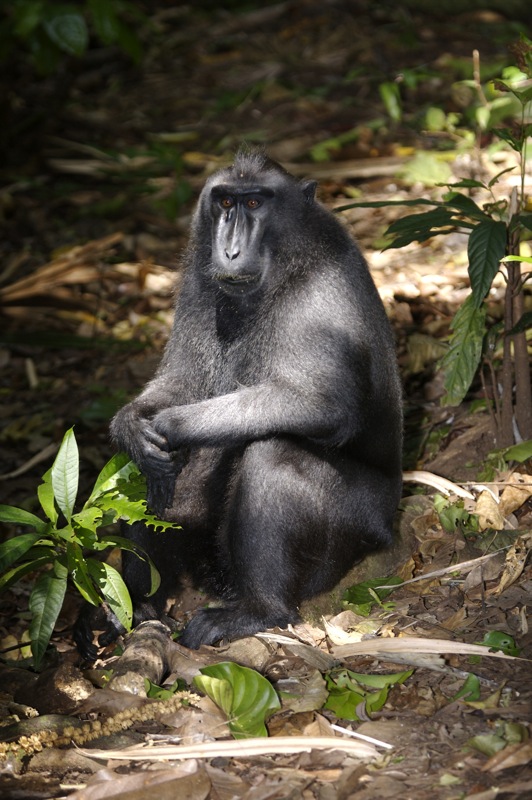
The Black Crested Macaque (Yaki)
You will almost certainly hear the Yaki (*Macaca nigra*) before you see them. The sound of cracking branches, soft grunts, and the rustle of a large group moving through the undergrowth announces their arrival.
Suddenly, they are all around you. With their jet-black fur, striking punk-rocker crest of hair, and intelligent, expressive faces, the Black Crested Macaques are the park's most iconic residents. Unlike many primates, they spend a great deal of their time on the forest floor, foraging in large, complex social groups that can number over 50 individuals.
Observing them is like watching a live-action drama. Dominant males patrol the group's perimeter while mothers patiently groom their infants. Juveniles, full of energy, chase each other, wrestle, and tumble through the leaf litter.
What is most remarkable is their indifference to human presence. Years of careful, respectful tourism mean the macaques are habituated. They will go about their daily business—foraging, playing, grooming, and squabbling—often just a few meters away. This allows for an incredibly intimate and photographic experience, offering a profound glimpse into the complex social lives of these critically endangered monkeys.
The Spectral Tarsier by R.Rahasia - Wikipedia
As the afternoon light begins to fade and the Yaki troops prepare to settle for the night, the objective of the trek shifts. The guides lead you to a different part of the forest, often to a specific, hollowed-out tree. And then, you wait.
This is the second main event. As dusk settles and the jungle's daytime sounds are replaced by the chirps and clicks of nocturnal insects, you search for movement.
Then, from the darkness of its sleeping hole, a pair of enormous, luminous eyes will appear. This is the Spectral Tarsier (*Tarsius tarsier*), one of the smallest primates in the world. Barely larger than an adult's fist, this tiny, nocturnal creature is an evolutionary marvel. Its head can rotate nearly 180 degrees, and its eyes, relative to its body size, are the largest of any mammal.
You will watch, mostly in silence, as the Tarsier family—usually a mated pair and their offspring—emerges. They cling vertically to trunks, their long, slender fingers and toes giving them an alien-like appearance. They communicate in high-pitched chirps before launching themselves with explosive power, leaping several meters from tree to tree to begin their nightly hunt for insects. The encounter is brief, conducted in low light to protect their sensitive eyes, but it is an unforgettable and captivating experience.


Beyond the Primates: A Richer Ecosystem
While the primates may be the stars, they are supported by a vast cast of other fascinating wildlife. As you trek, your guide’s trained eyes will scan the canopy for other, shyer residents. A sudden, loud *whooshing* sound overhead signals the flight of the Knobbed Hornbill. Higher up, and much harder to spot, is the Bear Cuscus (*Ailurops ursinus*), a slow-moving, tree-dwelling marsupial.
The forest is also a paradise for birdwatchers. Colorful Kingfishers, endemic Pittas, and elegant Paradise Flycatchers flit through the lower storeys.
The Keepers of the Forest: The Local Guides
A trip into Tangkoko is not a solitary endeavor. The experience is made possible by the park's exceptional local guides. These men and women, many of whom grew up in the villages bordering the park, are the true interpreters and guardians of this ecosystem.
Their knowledge is not learned from books; it is generational. Where a visitor sees only a wall of green, a guide sees a story. They are, in every sense, essential.
Timing Your Visit: The Rhythm of the Forest
Tangkoko operates on two main schedules, each offering a distinct experience.
- The Morning Trek (Starts at 6:00 AM): For early risers, this is a magical time. The air is at its coolest and freshest. This is the best time for birdwatching and seeing the Black Crested Macaques as they start their day.
- The Afternoon Trek (Starts at 3:00 PM): This is the most popular option. You begin in the warm afternoon light, spending time with the macaques, and the trek culminates in the unique and memorable sighting of the Tarsiers as they wake for the night.
A Final Word
Tangkoko National Park is a vital counter-narrative to North Sulawesi's tourism story. It is a powerful testament to the incredible biodiversity that exists *beyond* the reef. It is a chance to walk among some of the planet's most unique creatures and to leave with a profound appreciation for the green heart of this remarkable Indonesian province.
Ready to Explore the Jungle?
Our guided treks are designed to maximize your chances of spotting wildlife, from the Yaki to the Tarsier. Let us show you the wonders of Tangkoko.
Contact Us Now